


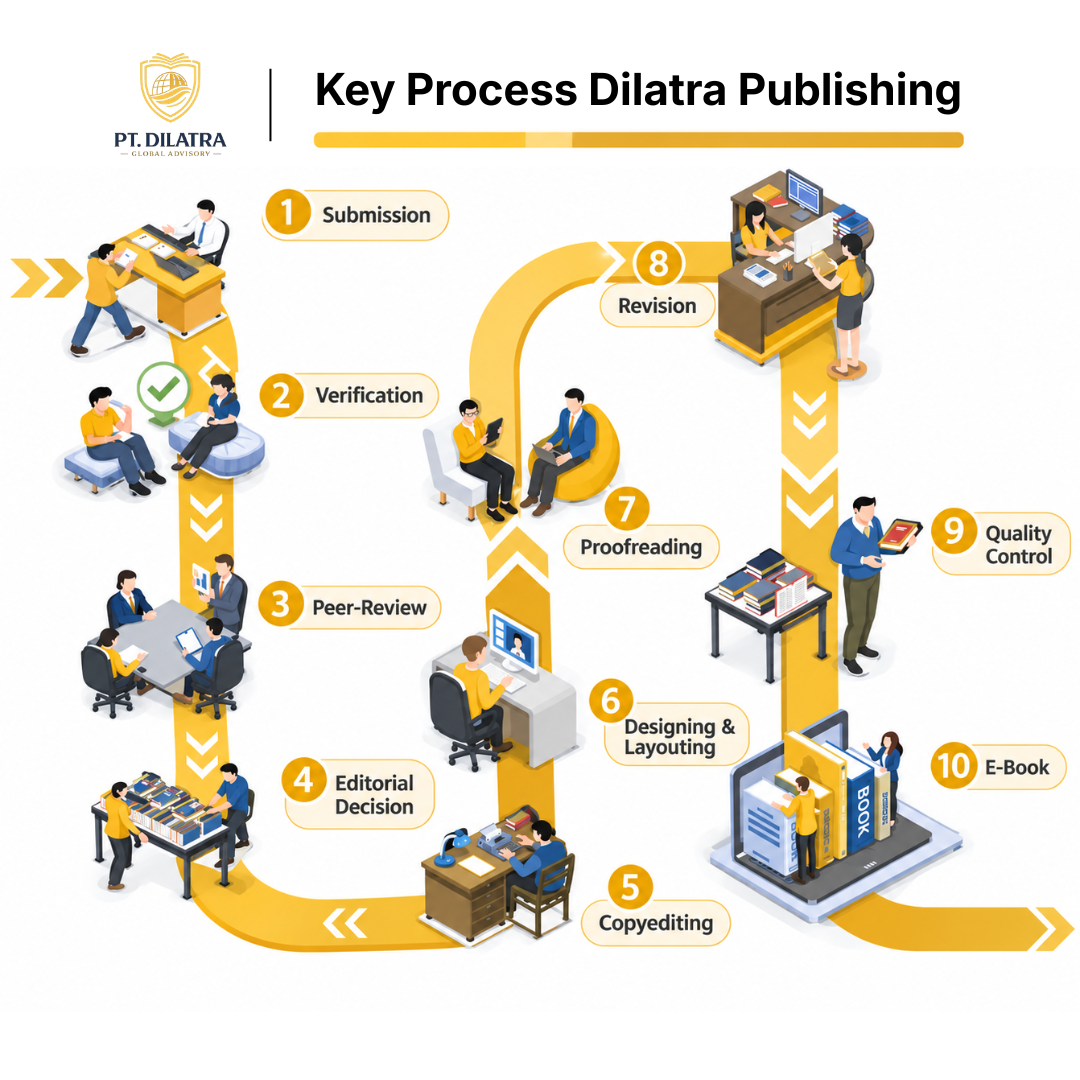
Book publication proposals are accepted throughout the year by PT. Dilatra Global Advisory. The maximum duration of the complete publication process is nine (9) months, calculated from the date of manuscript submission until the official announcement of the publication decision. The timeline provided below serves as an indicative schedule and may vary depending on manuscript complexity, author responsiveness, and compliance with publication requirements.
The publication process consists of the following stages:
Stages 1 & 2: Manuscript Submission and Verification (24 Working Days)
Authors submit their book manuscripts, which are subsequently checked for completeness, formatting, originality, and compliance with the publisher's submission requirements.
Stage 3: Peer Review (56 Working Days)
Submitted manuscripts undergo an evaluation process by qualified reviewers to assess their academic quality, originality, relevance, and contribution to the development of knowledge.
Stage 4: Editorial Decision (11 Working Days)
The editorial team evaluates the review results and communicates the final editorial decision to the corresponding author.
Stage 5: Copyediting (16 Working Days)
Accepted manuscripts undergo language editing, consistency checks, and editorial refinement to ensure clarity, accuracy, and readability.
Stages 6, 7, 8 & 9: Book Production (62 Working Days)
This stage includes manuscript layout, cover design, proofreading, author corrections, quality control, and ISBN application.
Stage 10: E-Book Publication (16 Working Days)
The final stage includes e-book preparation, metadata creation, final file processing, online publication, DOI activation (where applicable), and legal deposit submission to relevant national and regional libraries, subject to applicable requirements.
PT. Dilatra Global Advisory is committed to maintaining the highest standards of publication ethics and intellectual integrity in all aspects of its book publishing activities. The publisher upholds the principles of copyright protection, privacy, licensing, transparency, and responsible scholarly communication.
Every book published by PT. Dilatra Global Advisory is expected to provide meaningful academic, professional, and intellectual contributions to its readers. The publisher emphasizes originality, authenticity, relevance, and the advancement of knowledge.
This Publication Ethics and Malpractice Statement establishes the ethical responsibilities and professional standards applicable to authors, editors, peer reviewers, and publisher management. These principles are intended to prevent publication misconduct, including plagiarism, duplication, fabrication, falsification, unauthorized use of intellectual property, and other forms of unethical publishing practices.
PT. Dilatra Global Advisory recognizes the importance of ethical principles in academic and professional publishing. The publisher is committed to ensuring that all manuscripts undergo a transparent, objective, and responsible editorial and peer-review process.
In accordance with the principles and best practices of the Committee on Publication Ethics (COPE), this statement establishes clear ethical expectations for all parties involved in the publication process, including authors, editors, reviewers, and publisher management.
All stakeholders are expected to uphold academic integrity, professional responsibility, and ethical conduct throughout the publication process. These principles serve as a foundation for preventing publication malpractice and maintaining the credibility of published works.
PT. Dilatra Global Advisory upholds the principles of diversity, equality, and inclusion throughout its publishing activities.
The publisher ensures that all submitted manuscripts are evaluated objectively and fairly based on their academic quality, originality, relevance, and contribution to their respective fields.
No author or contributor shall be discriminated against on the basis of gender, ethnicity, religion, race, nationality, institutional affiliation, political background, or any other personal or social characteristic.
Editorial and publication decisions shall remain independent and shall be based solely on professional and scholarly considerations.
PT. Dilatra Global Advisory recognizes that responsible publishing plays an essential role in developing a credible and sustainable knowledge ecosystem.
The publisher is committed to establishing and maintaining ethical standards for all parties involved in book publishing, including authors, editors, peer reviewers, and publisher management.
The publisher is responsible for overseeing the publication process and ensuring that editorial decisions are made independently, transparently, and without inappropriate external influence.
Commercial interests, advertising revenue, institutional relationships, or other financial considerations shall not interfere with editorial independence or compromise the integrity of publication decisions.
PT. Dilatra Global Advisory also encourages appropriate cooperation and communication with other publishers and scholarly organizations to promote responsible publishing practices.
Research and publication misconduct includes, but is not limited to, fabrication, falsification, plagiarism, citation manipulation, duplicate publication, and other unethical practices occurring during research, manuscript preparation, evaluation, or publication.
PT. Dilatra Global Advisory considers the investigation of suspected misconduct an essential responsibility of the editorial team.
All allegations shall be handled objectively, confidentially, and in accordance with established publication ethics principles and relevant COPE guidelines.
When misconduct is suspected, the corresponding author will be contacted and given an opportunity to provide an explanation and supporting evidence. Additional assessments or expert consultations may be conducted when necessary.
If sufficient evidence of misconduct is established, the publisher may reject the submitted manuscript or take appropriate post-publication actions, including corrections, retractions, or withdrawal of published materials.
Where concerns can be resolved through clarification or additional verification, the publisher may issue an appropriate correction or clarification notice.
PT. Dilatra Global Advisory is committed to protecting the accuracy, reliability, and integrity of the scholarly and professional record.
Authors must ensure that authorship accurately reflects the intellectual and academic contributions of every individual involved in the preparation of a book manuscript.
Only individuals who have made substantial contributions to the conception, development, research, writing, or interpretation of the work should be included as authors.
Individuals who have provided significant assistance but do not meet the criteria for authorship should be appropriately acknowledged in the manuscript.
All listed authors must review and approve the final manuscript before submission and publication. They must also agree to the authorship arrangement and take responsibility for their respective contributions.
Any changes to authorship, including additions, removals, or changes in author order, must be agreed upon by all authors and approved by the editorial team.
PT. Dilatra Global Advisory provides a mechanism for receiving and addressing complaints and appeals concerning its publishing activities.
Complaints may relate to editorial decisions, publication procedures, unethical citation practices, reviewer bias, conflicts of interest, peer-review irregularities, or other concerns involving the publisher, editorial team, or reviewers.
All complaints shall be handled fairly, transparently, and confidentially. The publisher will examine each complaint objectively and take appropriate action based on the nature of the issue.
Appeals against editorial decisions must include a reasonable explanation and relevant supporting evidence.
The handling of complaints and appeals shall follow applicable publication ethics principles and COPE recommendations.
PT. Dilatra Global Advisory encourages authors to maintain accurate, complete, and accessible research data supporting the content of their manuscripts.
Authors may be requested to provide relevant raw data, research materials, references, or supporting documentation during the editorial and peer-review process.
Where appropriate and legally permissible, authors are encouraged to make their research data available to the public or retain it for a reasonable period following publication.
Authors are responsible for ensuring that their data and research materials are sufficiently documented to support verification, transparency, and reproducibility.
Confidential, personal, or sensitive information must be handled in accordance with applicable privacy and data protection requirements.
Authors conducting research involving human participants, animals, hazardous materials, potentially dangerous procedures, or sensitive information must comply with applicable ethical and legal requirements.
Where required, authors must obtain ethical approval or clearance from an authorized institutional ethics committee or relevant regulatory body before conducting the research.
Any potential risks, ethical considerations, and necessary safeguards must be clearly disclosed in the manuscript.
For research involving confidential information, business records, personal data, or proprietary materials, authors must explain how confidentiality, privacy, and data security have been maintained.
PT. Dilatra Global Advisory reserves the right to request supporting ethical approval documents or additional explanations when necessary.
Authors submitting manuscripts to PT. Dilatra Global Advisory are expected to comply with the following ethical principles:
Reporting: Authors must present their research processes, findings, and conclusions accurately, clearly, objectively, and comprehensively. All information and data included in the manuscript must be reported honestly and transparently.
Originality: Submitted manuscripts must represent original intellectual work. Authors must ensure that their manuscripts have not been previously published in substantially similar form or simultaneously submitted to another publisher. Any form of plagiarism or duplicate publication is strictly prohibited.
Proper Citation: Authors must acknowledge all sources of information, ideas, data, and materials used in their manuscripts. References and bibliographies must be presented accurately and consistently. Using another person's work without appropriate attribution is prohibited.
Responsibility: Authors bear full responsibility for the accuracy of their research data, methodology, analysis, calculations, interpretations, and written content. Authors must be willing to provide clarification or supporting evidence when requested by the editorial team or reviewers.
Authorship Agreement: Authors must ensure that all individuals listed as authors have made appropriate contributions and have approved the final manuscript. Any changes to the authorship list must receive the agreement of all affected authors.
Acknowledgment: Individuals or institutions that provide meaningful assistance without qualifying for authorship must be appropriately acknowledged.
Punctuality: Authors are expected to respond to editorial correspondence, complete revisions, and submit corrected manuscripts within the deadlines established by the publisher. Delays may affect the publication schedule.
Disclosure of Conflicts of Interest: Authors must disclose any financial, professional, institutional, or personal relationships that could influence the preparation, evaluation, or interpretation of their work.
Editors at PT. Dilatra Global Advisory must maintain professional standards and comply with the following ethical principles:
Neutrality: Editors must evaluate manuscripts objectively and fairly without discrimination based on authors' personal backgrounds, institutional affiliations, gender, ethnicity, religion, race, or nationality.
Editorial Integrity: Editorial decisions must be based on the manuscript's originality, quality, relevance, and contribution to knowledge rather than personal preferences or external interests.
Transparency: Editors must communicate editorial decisions, review outcomes, revision requirements, and publication procedures clearly and accurately.
Effective Communication: Editors must maintain professional and respectful communication with authors, reviewers, and publisher management throughout the publication process.
Fair Assignment: Manuscripts must be assigned to appropriate reviewers and editorial personnel based on their academic qualifications, professional competence, and relevant expertise.
Professional Responsibility: Editors must ensure that every manuscript undergoes the required editorial assessment and peer-review procedures before publication.
Confidentiality: Editors must protect unpublished manuscripts and confidential information obtained during the editorial process. Such information must not be used for personal or professional advantage.
Disclosure of Conflicts of Interest: Editors must disclose any potential conflicts of interest and withdraw from editorial handling when their impartiality may reasonably be questioned.
Peer reviewers play an essential role in maintaining the academic quality and credibility of books published by PT. Dilatra Global Advisory.
Reviewers are expected to comply with the following ethical principles:
Neutrality and Objectivity: Reviewers must evaluate manuscripts fairly, independently, and objectively. Assessments must be based on scholarly merit, originality, relevance, and methodological quality rather than the author's identity or background.
Professional Competence: Reviewers should only accept manuscripts that fall within their areas of expertise. If a manuscript does not correspond to their knowledge or qualifications, they should decline the invitation or recommend another qualified reviewer.
Constructive Evaluation: Reviewers must provide clear, relevant, and constructive comments intended to improve the quality, accuracy, and academic contribution of the manuscript.
Confidentiality: Manuscripts received for review must be treated as confidential documents. Reviewers must not disclose, distribute, or use unpublished information for personal or professional benefit.
Quality Assurance: Reviewers should assess the originality, relevance, validity, methodology, accuracy, and contribution of the submitted work.
Timeliness: Reviewers are expected to complete their evaluations within the agreed timeframe. If additional time is required, they must inform the editorial team promptly.
Disclosure of Conflicts of Interest: Reviewers must disclose any financial, institutional, professional, or personal relationships that may compromise their impartiality. They must decline assignments where a significant conflict of interest exists.
The management of PT. Dilatra Global Advisory is responsible for establishing and maintaining an ethical, transparent, and sustainable publishing environment.
Publisher management is expected to comply with the following principles:
Decision-Making: Publisher management must establish the vision, mission, objectives, and publishing policies of the organization while respecting the independence of editors and reviewers in their professional responsibilities.
Editorial Independence: Publisher management must provide editors and reviewers with the freedom to perform their duties independently and without inappropriate commercial, personal, or institutional interference.
Intellectual Property Protection: The publisher must respect and protect the intellectual property rights of authors and other contributors through appropriate copyright, licensing, and publication agreements.
Ethical Compliance: Publisher management must support the implementation of ethical standards, including confidentiality, licensing requirements, research ethics, and applicable legal obligations.
Publishing Responsibility: The publisher is responsible for establishing clear policies concerning publication scope, manuscript requirements, editorial procedures, licensing, publication agreements, and quality assurance.
Sustainability: Publisher management must maintain the operational and financial sustainability of publishing activities without compromising editorial integrity or academic quality.
Promotion and Dissemination: The publisher should promote published works through appropriate channels to improve accessibility, visibility, and the dissemination of knowledge.
Disclosure of Conflicts of Interest: Publisher management must disclose and appropriately manage potential conflicts of interest that could affect publishing decisions or organizational integrity.
For further information regarding publication ethics and responsible scholarly publishing, authors, editors, and reviewers are encouraged to consult the Committee on Publication Ethics (COPE) at https://publicationethics.org/.
PT. Dilatra Global Advisory respects the intellectual property rights of authors and contributors.
Copyright ownership, licensing arrangements, and permissions for the use and distribution of published e-books shall be governed by the publisher's Copyright and Licensing Policy and the applicable publication agreement.
Authors are responsible for ensuring that all materials included in their manuscripts, such as text, images, tables, illustrations, and other third-party content, have appropriate permissions or legal grounds for use.
The publisher is committed to protecting intellectual property rights and addressing copyright violations in accordance with applicable laws and publication ethics standards.
PT. Dilatra Global Advisory welcomes feedback, academic discussions, and correction requests concerning published books and other scholarly materials.
Readers, authors, and other interested parties may submit comments or report potential errors, inaccuracies, or ethical concerns to the publisher through its official communication channels.
All submissions will be evaluated by the editorial team. When a correction is considered necessary, the publisher may issue an official correction notice or update the relevant publication files, while maintaining transparency regarding the changes made.
Authors of the original work may be invited to provide clarification or a response when appropriate.
The publisher aims to ensure that all post-publication updates preserve the accuracy, reliability, and integrity of the published record.
PT. Dilatra Global Advisory implements a peer-review process to ensure that every submitted book manuscript meets appropriate academic, professional, and editorial standards.
Manuscripts are evaluated based on several criteria, including:
Originality and novelty of the work.
Relevance to the intended subject area.
Accuracy and validity of the content.
Appropriateness of research methods and approaches, where applicable.
Quality of analysis, discussion, and interpretation.
Contribution to academic, professional, or practical knowledge.
Accuracy and relevance of references and supporting materials.
Authors will receive relevant reviewer comments and may be required to revise their manuscripts accordingly.
The editorial team evaluates the reviewers' recommendations and the authors' revisions before making the final publication decision.
The peer-review process is conducted to maintain objectivity, transparency, academic integrity, and the overall quality of published books.
PT. Dilatra Global Advisory maintains a strict policy against plagiarism, self-plagiarism, duplicate publication, and other forms of unauthorized use of intellectual property.
All submitted manuscripts may undergo similarity screening using recognized plagiarism-detection tools.
The publisher establishes a maximum similarity threshold of 30% as a general screening reference. However, similarity reports are assessed contextually and are not treated as automatic evidence of plagiarism.
The editorial team examines the originality of the manuscript, proper citation practices, unattributed textual overlap, duplicate content, and inappropriate paraphrasing.
Manuscripts found to contain plagiarism or other forms of publication misconduct may be returned for correction or rejected, depending on the severity of the violation.
The publisher reserves the right to take further action if plagiarism or other ethical violations are identified after publication.
PT. Dilatra Global Advisory establishes procedures for handling manuscript withdrawal, publication corrections, retractions, and other necessary post-publication actions.
Authors who wish to withdraw a manuscript before publication must submit a formal request to the editorial team, accompanied by a clear explanation of the reasons for withdrawal.
Withdrawal requests will be evaluated to ensure that they are legitimate and do not violate publication agreements or ethical responsibilities.
Corrections may be issued when errors are identified in published materials that do not fundamentally invalidate the overall work.
Retractions may be considered when serious issues are established, including plagiarism, fabrication, falsification, duplicate publication, or other significant breaches of publication ethics.
All correction and retraction decisions shall be handled transparently and in accordance with applicable publication ethics guidelines.
The publisher is committed to maintaining the accuracy, credibility, and integrity of all published materials.